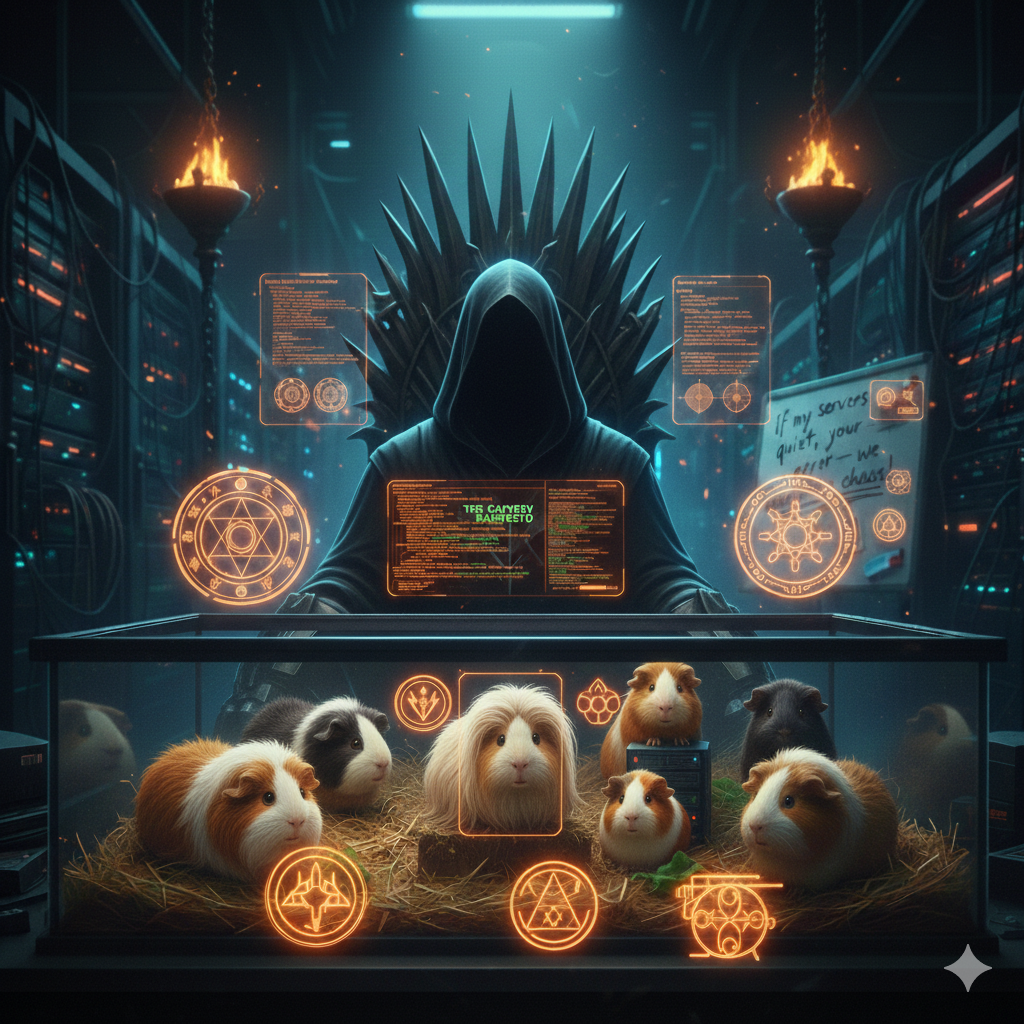


The Guinea Pig Philosophy
If you look into the cage of my six guinea pigs, you’ll see a masterclass in essentialism. They have hay, water, and fresh vegetables. They don’t have “social media for rodents” or a “proprietary hay-delivery API” that requires a monthly subscription. They have exactly what they need to thrive, and nothing more.
In the modern web, we’ve forgotten this simple wisdom. We’ve traded the clarity of a single seed for a mountain of digital junk food. We build systems that are obese with unnecessary code, bloated with trackers, and heavy with frameworks we don’t understand. We have forgotten that in nature, and in engineering, simple is efficient.
The Obesity of Modern Tech
The modern DevOps challenge is the Dependency Tax. We live in an era of “Move Fast and Bloat Things.” We pull in 400 npm packages just to center a div. We deploy entire Kubernetes clusters to host a landing page that gets ten visitors a day. This bloat isn’t just a performance issue; it’s a security risk, a maintenance nightmare, and a direct drain on your digital sovereignty.
As a Master 2 DevOps student and Senior Support lead, I’ve seen projects collapse under their own weight. I’ve seen teams paralyzed because a single library maintained by a guy in Nebraska (thank you, xkcd) got deprecated. Every dependency is a promise you might not be able to keep. We’ve become the janitors of our own excess, cleaning up the digital debris of a culture that values “features” over “foundations.”
Sustainability Through Scarcity
My philosophy is rooted in Sustainability Through Scarcity. I only feed my infrastructure exactly what it needs to survive. This means:
– Linux (Debian): The bedrock. It’s boring, stable, and predictable.
– Docker: The isolated process. It keeps the mess contained.
– Postgres: The trusted storage. No fancy NoSQL unless I have a NoSQL problem.
– Ansible: The surgical automation. Reproducible state without the daemon overhead.
I treat every new dependency like a threat to my peace of mind. If it doesn’t solve a core problem with 10x more efficiency than a simple shell script, it doesn’t get a seat at the table. This minimalism isn’t about being “retro” or refusing to progress; it’s about being Resilient. A system with fewer moving parts is a system that stays up while the complex towers are crumbling.
Audit Your Diet
Audit your `package.json` and your `docker-compose.yml` today. Ask yourself: *f this dependency disappeared tomorrow, would my project die? If the answer is “I don’t know,” then you’ve allowed a stranger to own a piece of your digital home.
Slashing the dependency tax isn’t just about speed; it’s about freedom. Simplify your stack. Feed your infrastructure like I feed my guinea pigs: only the essentials, delivered with precision.
Build small. Stay strong.