

The “New is Always Better” Lie
In the volatile ecosystem of 2026, where “cutting-edge” kernels are released on Tuesday and broken by Thursday, there is a quiet, almost sci-fi rebellion in choosing technology that refuses to change. While the rest of the world is chasing the dopamine hit of the latest rolling release, updating their servers like they update their TikTok feed, I’m sitting here with Debian 12 “Bookworm.” It is the tectonic plate of my infrastructure—unmoving, massive, and entirely reliable.
We are culturally conditioned to believe that “legacy” is an insult and “modern” is a virtue. But in the world of infrastructure, “boring” isn’t a lack of features; it’s a lack of surprises. And when you are running production workloads, a surprise is just a polite word for an outage.
The Hidden Cost of the Bleeding Edge
The tech industry has a pathological obsession with the new. We are told that if we aren’t using the latest version of everything, we are falling behind. But as someone who spent years in Senior Support, I know the truth: New is fragile. Every time you chase a version number, you trade a piece of your sanity for a feature you might not even use.
For a solo operator, every minute spent debugging a system regression is a minute stolen from creation. I’ve seen developers lose entire weekends because an automatic update deprecated a library they didn’t even know they were using. That isn’t progress; it’s self-inflicted sabotage. When you run Arch or Fedora on a server, you aren’t an admin; you’re a beta tester who pays for the privilege of finding bugs.
The Iron Throne of Infrastructure
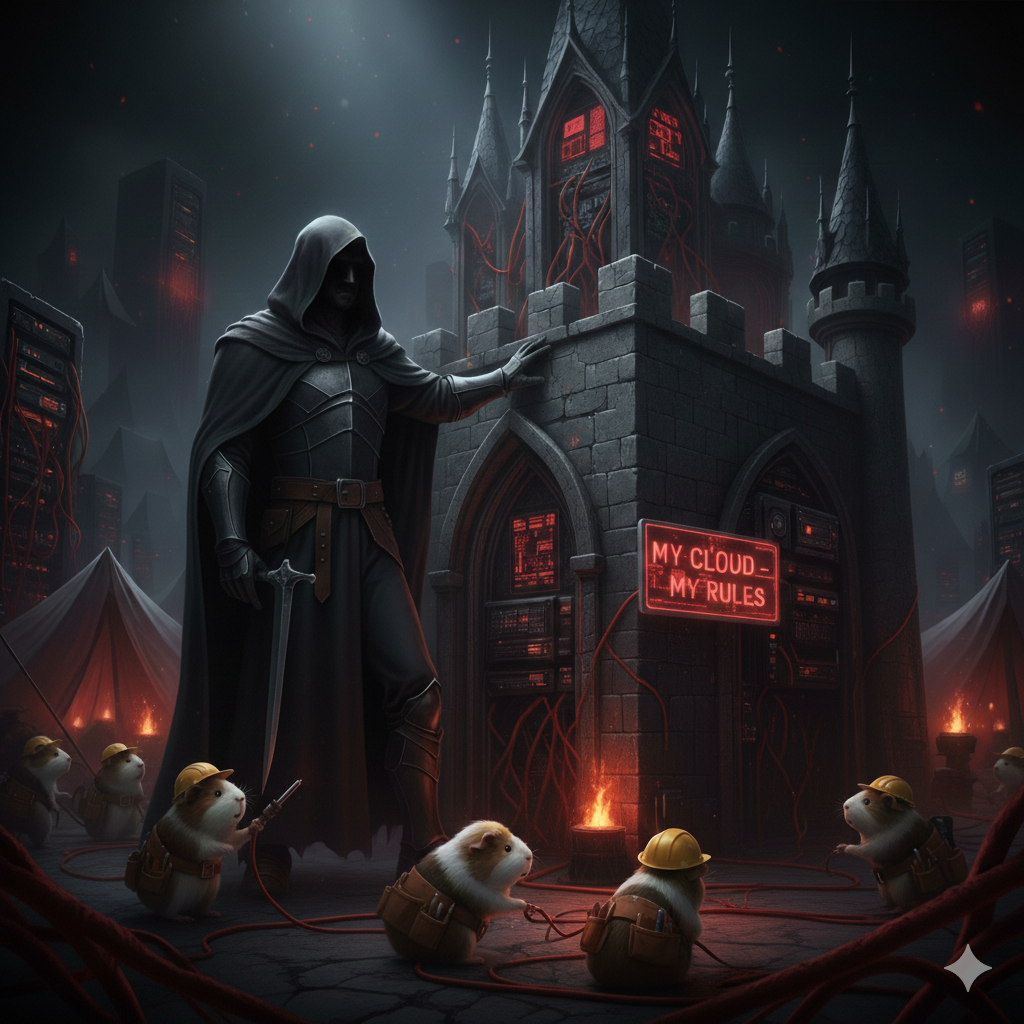
My six guinea pigs don’t care about my uptime, but they do enjoy the fact that I’m not screaming at a terminal on a Friday night because a kernel update nuked my network drivers.
Choosing Debian is a philosophical choice. It’s an acknowledgment that Boring is a Feature. By building on a foundation of iron and dust, I free my mind to focus on the application layer. I use Docker for the “new” stuff the apps, the runtimes, the experiments—but the ground it sits on is Debian stone. It’s the “Iron Throne” of stability, it doesn’t care about the hype cycles; it just stays up for 800 days and asks for nothing in return.
This separation of concern boring OS, exciting container is the only way to stay sane in the 2020s. Let the containers crash; the kernel remains unmoved.
Build on Bedrock, Not Quicksand
Look at your server uptime. If you can’t remember the last time you had to “rebuild” your OS because it got messy, you’re doing it right. If you’re constantly fighting your OS just to keep your apps running, it’s time to move to the swirl.
Put down the “bleeding edge” blade. Sit on the stone throne. Let the world rush past while you build something that actually lasts. Stability isn’t flashy, and it won’t get you likes on Twitter, but it will give you the one thing money can’t buy: peace.