
The Ego of the “Day One” Cluster
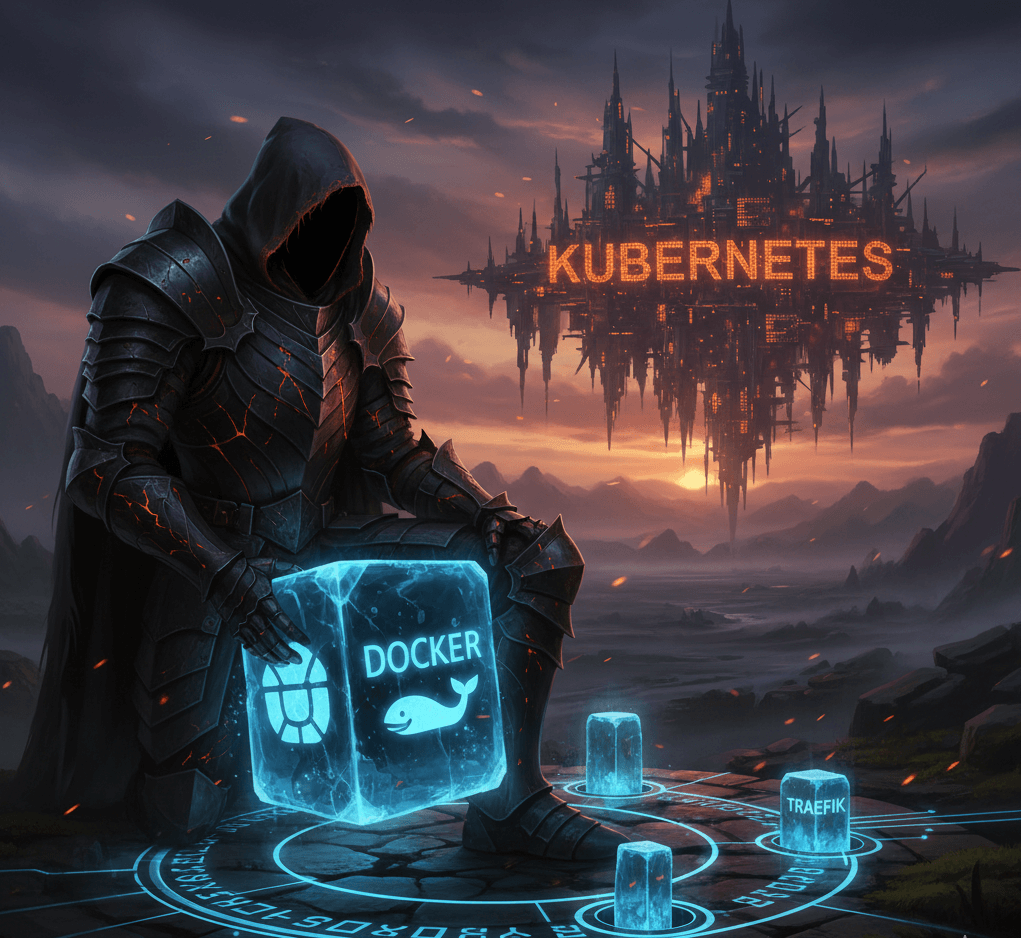
In the DevOps world, there’s a specific kind of “tryhard” behavior: the urge to deploy a highly available Kubernetes cluster for a personal lab before you’ve even mastered a single container’s lifecycle. We’ve been told that if you aren’t using K8s, you aren’t doing “real” DevOps.
I call it the K8s Noob Trap. It’s the act of burying yourself in the complexity of an orchestrator before you understand the physics of the wing. Knowledge is power, but only if that knowledge has a solid foundation. You don’t learn to fly by jumping out of a plane with a manual; you learn how the engine works first.
The Roadmap: Building a Fortress, Not a Sandcastle
I am writing this because I’ve intentionally chosen to stick with Docker and Docker Compose as my baseline. My roadmap is incremental, not impulsive. I am optimizing for mastery, and that requires a tiered approach:
1. The Foundations: State and Security
Before I scale, I need to know the house won’t burn down.
- Security & Identity: Implementing Traefik for reverse proxying and Authentik for identity management. If I can’t secure a single entry point, I have no business managing a cluster.
- Secret Management: Moving away from plain-text environment variables and using HashiCorp Vault.
- Observability: Setting up Grafana monitoring and alerting. If I can’t see the failure before it happens, I’m just a hobbyist.
- The Safety Net: Mastering off-site backups with Backblaze. Data is the asset; the infrastructure is just the wrapper.
2. The Automation: Removing the Human Element
Once the manual setup is rock-solid, I automate the friction out of it.
- Infrastructure as Code: Using Terraform to provision and Ansible to configure.
- GitOps: Implementing Gitea and GitHub Actions. If the change isn’t in Git, it doesn’t happen. This builds the “Source of Truth” mindset required for K8s.
Why Bother with the “Easy” Way?
Some think heading first for the most difficult tool is the fastest way to learn. They are wrong.
- Networking Literacy: If you can’t debug a Traefik middleware or a Docker bridge network, you will be paralyzed when a Kubernetes CNI fails.
- Mastering the YAML: Compose is the “distilled” version of the problems K8s solves. Master the syntax here, where the stakes and the complexity are manageable.
- Incremental Complexity: By the time I reach for Kubernetes, I won’t be fighting the concepts of networking, secrets, or GitOps—I’ll already have those in my pocket. I’ll only be learning the orchestrator itself.
Earn the Right to Scale
Infrastructure is a tool for productivity, not a monument to your pride. Building a solid foundation in Docker and Compose isn’t “settling”—it’s engineering. It’s about knowing exactly what happens when a packet hits your interface or a backup script fails.
Master the small things, secure the perimeter, and only then tackle the giants. Because as we know, my friend: Knowledge is power.
Technical Reference: